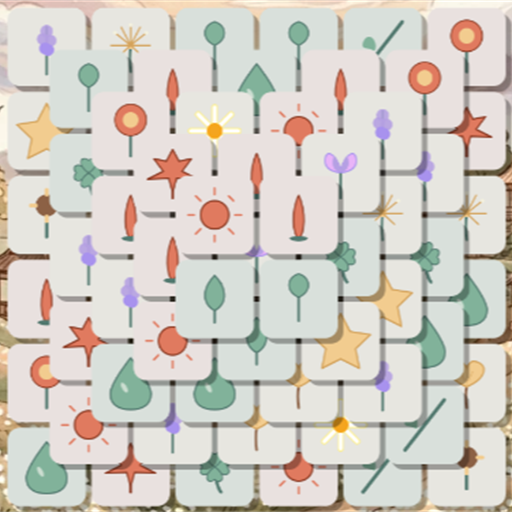
Complete Game Guide & Strategy Manual: Mastering Triple Match Relaxed
Welcome to the official player handbook for Triple Match Relaxed. Whether you are taking your very first steps into our serene botanical gardens or looking to refine your spatial reasoning for high-tier stages, this comprehensive guide explains every mechanic, obstacle, booster, and rescue system in detail.
1. Understanding the Core Philosophy: Zero-Pressure Puzzle Solving
Unlike conventional arcade match-3 games that rely on flashing countdown clocks, aggressive failure penalties, and sensory overload, Triple Match Relaxed is built around the concept of Mindful Flow. There is no timer ticking down at the top of the screen. Every puzzle is a self-contained spatial arrangement where you can take as much time as you need to observe the board, plan your sequence of moves, and enjoy the acoustic wind chimes and ambient nature sounds.
The objective of every stage is straightforward: clear the entire board of artisanal tiles by collecting matching trios into your holding tray at the bottom of the screen. However, beneath this simple rule lies a rich layer of tactical depth involving tile occlusion, tray capacity management, and pattern recognition.
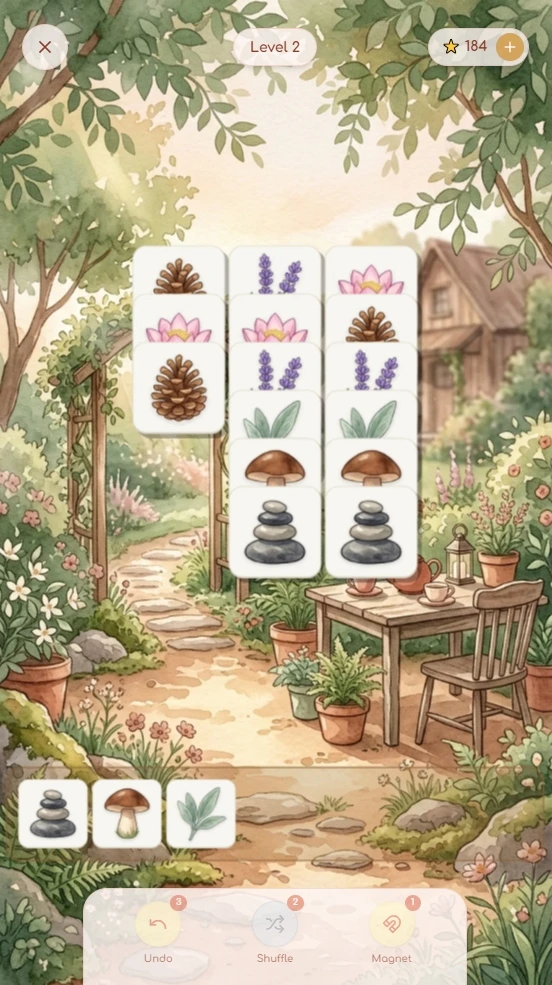
2. Fundamental Mechanics & The 7-Slot Holding Tray
2.1. Tile Selection and Trio Elimination
The game board consists of stacked ceramic tiles adorned with hand-painted botanical, seasonal, and Zen motifs—such as lotus blossoms, bamboo shoots, origami cranes, warm teacups, and autumn maple leaves. A tile is selectable (highlighted in full brightness) only when no other tile is resting directly on top of it. Tiles that lie on deeper layers appear shaded and cannot be tapped until the tiles covering them have been removed.
When you tap an available tile on the board, it glides smoothly into the Holding Tray (also known as the Dock) at the base of the screen. This tray holds up to 7 slots. Whenever three identical tiles are present in the tray, they automatically merge and vanish in a burst of watercolor petals, freeing up three slots for future selections and awarding Golden Star progress.
2.2. Smart Auto-Sorting in the Tray
To keep your visual workspace tidy, the holding tray automatically groups identical tiles side by side. For example, if your tray currently contains a Bamboo tile and a Lotus tile, and you select a second Bamboo tile from the board, the newly picked tile will slide directly next to the first Bamboo tile rather than appending to the far right end. This makes it effortless to see at a glance how many pairs you are holding and how many empty slots remain.
3. Multi-Layer Board Reading & Spatial Strategy
As you progress through the chapters of Triple Match Relaxed, puzzle formations evolve from flat two-dimensional layouts into intricate three-dimensional pyramids, concentric mandalas, and interlocking bridges. Winning consistently without expending Golden Stars requires developing three essential habits:
3.1. Prioritize Deep Stacks Over Isolated Flat Tiles
Beginners often clear pairs of tiles sitting around the outer edges of the board because they are easy to spot. However, isolated edge tiles do not unlock any new options underneath them. Instead, always scan the thickest central stacks first. Removing a single tile from the peak of a five-layer tower can expose two to four hidden tiles beneath it, dramatically increasing your tactical choices for subsequent turns.
3.2. Peek at Partially Covered Shadows
Because tiles in Triple Match Relaxed are arranged on a precision sub-grid, lower-layer tiles frequently peek out slightly from beneath the edges of upper-layer tiles. Before committing to picking up a pair, examine the silhouettes and color corners of the shaded tiles directly below. Knowing that the third matching tile is only one layer deep allows you to confidently pick up the first two tiles even when the third is not yet selectable.
3.3. Keep "Insurance Trios" on the Board
If you spot three identical tiles that are all completely uncovered and sitting on the bottom-most layer, resist the urge to clear them right away. Leave them on the board as an "insurance trio." Later in the stage, if you need to advance an Ice Tile thaw counter or water a Blooming Flower without risking tray congestion, you can tap those three guaranteed tiles at any moment.
4. Complete Guide to the 3 Mindful Boosters & Two-Tier Rescue Miracles
Even the most experienced puzzle master encounters complex board states where deeply nested tiles create temporary bottlenecks. Triple Match Relaxed provides three dedicated tactical boosters at the bottom of the screen, complemented by a unique Two-Tier Rescue System when your tray reaches capacity:
↩️ 1. Undo (Step Back)
Reverts your most recent tile pick, flying the last tile placed into your holding tray back to its exact original $(X, Y, Z)$ coordinate on the board. Ideal when you tap a surface tile to peek underneath it and realize the buried tile wasn't the one you needed. Note that Undo cannot reverse a trio that has already merged and vanished.
🔀 2. Shuffle (Board Rebalance)
Swirls all remaining tiles on the board into a soothing vortex and redistributes their painted motifs while preserving the physical 3D pyramid structure. Use Shuffle when all matching third tiles are trapped at the very bottom of deep stacks.
🧲 3. Magnet (Adaptive Tray Relief)
Our signature intelligent booster that dynamically adapts to your remaining empty tray slots!
• 3+ empty slots: Pulls a full trio (3 tiles) from anywhere on the board (even
buried layers).
• 2 empty slots: Targets a single tile already in your tray and pulls its 2
matching partners from the board.
• 1 empty slot: Targets an existing pair in your tray and pulls the 1 missing tile
to clear the trio. If your tray has 6 singletons and no pair, Magnet automatically locks itself so it never
causes an accidental tray overflow!
4.1. The Two-Tier Rescue System: Peaceful Wooden Shelf & Returning Breeze
What happens if all 7 slots of your holding tray fill up without completing a match? Instead of an abrupt game-over screen, Triple Match Relaxed offers two gentle, sequential rescue miracles:
- Tier 1 Rescue — Gentle Breeze & The Peaceful Wooden Shelf (2 Auxiliary Slots): When your 7-slot dock fills up for the first time, you can summon a Gentle Breeze. This lifts up to 2 tiles from the rightmost end of your tray and places them onto the Peaceful Wooden Shelf—a 2-slot auxiliary wooden ledge resting just above your main dock. Tiles on the Wooden Shelf remain fully visible and selectable at any time. Even better, thanks to Smart Match, if your main tray is at 7/7 capacity (or the shelf is at 2/2) and you already hold 2 matching tiles, the game still lets you tap the 3rd matching tile on the board to complete the trio immediately!
- Tier 2 Rescue — Returning Breeze (100 ⭐): If both your 7-slot holding tray AND both slots of the Peaceful Wooden Shelf (2/2) are occupied, the game presents a second-tier miracle: Returning Breeze. Invoking Returning Breeze sweeps the last 3 tiles from your holding tray and flies them gracefully back to their exact original $(X, Y, Z)$ positions on the board, immediately reopening 3 empty slots in your dock so you can continue solving without losing your stage progress.
5. Special Game Modes, Wallpapers & Share Economy
5.1. Mindful Wallpaper Sanctuary & Canvas Customizer
Every chapter you complete unlocks high-resolution vertical watercolor artworks in the Mindful Wallpaper Sanctuary. Using our built-in HTML5 Canvas Customizer Studio, you can personalize each artwork across three layout modes (Pure Minimalist, 18-Language Mindful Monthly Calendar, or Mindful Inscription Quotes), apply atmospheric lighting filters (Morning, Sunset, Moonlit Zen), preview on a realistic Lock Screen Simulator, and export crisp 1080p PNG wallpapers.
5.2. The Quiet Journal & 3D Wax-Sealed Postcards
Your mindfulness milestones are chronicled in the Quiet Journal. Unlocking achievements awards Golden Stars and collectible single-sided keepsake postcards stamped with an embossed crimson 3D Wax Seal. Sharing your milestones across the daily moments rewards you with +65 Golden Stars (⭐) every day (+15 ⭐ for Campaign Level victory share, +15 ⭐ for Silent Journey Endless victory share, +15 ⭐ for Quiet Journal achievement postcard share, and +20 ⭐ for custom Wallpaper share—plus an additional +20 ⭐ for New Seasonal Theme 100% Unlock share, totaling up to +85 ⭐/day).
5.3. Silent Journey (Endless Zen Mode)
For players seeking uninterrupted, continuous puzzle sessions, the Silent Journey mode (unlocked at Level 5) offers procedurally balanced puzzles that adapt smoothly to your rhythm. Your consecutive victories build a peaceful streak, accompanied by evolving ambient soundscapes that blend rain, temple bells, gentle streams, and soft acoustic melodies.
6. The Evolution & Combinatorial Mathematics of Tile-Matching Puzzles
To appreciate why 3D triplet-matching puzzles feel both intuitive and deeply engaging, it helps to examine the broader history and computer science of the genre. Tile-matching solitaire originated in 1981 when programmer Brodie Lockard created Mah-Jongg on the PLATO educational computing system, inspired by the traditional Chinese children's game 乌龟 (The Turtle). Classic Mahjong Solitaire used a 144-tile deck arranged in stacked layers where tiles were eliminated in pairs (modulo-2 matching), and a tile became selectable only if its top face was uncovered and either its left or right horizontal edge was free.
Modern 3D triplet puzzles like Triple Match Relaxed advance this mathematical foundation in two fundamental ways:
- Directed Acyclic Graph (DAG) Top-Down Occlusion: Instead of restricting selection to left/right edge freedom, each board is modeled as a 3D spatial Directed Acyclic Graph $G = (V, E)$, where each vertex $v \in V$ represents a tile with bounding box $(x_v, y_v, z_v)$ and a directed edge $u \to v$ exists whenever tile $u$ lies on a higher layer ($z_u > z_v$) and overlaps $v$ by at least 25% of its surface area ($\text{Area}(u \cap v) > 0$). A vertex $v$ is selectable if and only if its in-degree is zero ($\deg^-(v) = 0$).
- Modulo-3 Bounded-Buffer Queue (The 7-Slot Holding Tray): In pair-matching solitaire, two identical exposed tiles can be cleared immediately without intermediate storage. By requiring three identical tiles ($\text{count} \equiv 0 \pmod 3$) and introducing a bounded buffer of capacity $K = 7$, the puzzle transforms into a classic computer science resource-allocation problem. By the Pigeonhole Principle, holding three distinct tile types with two tiles each ($3 \times 2 = 6$ slots) leaves exactly 1 free buffer slot—the mathematical threshold where a single completing tile triggers a cascade reduction ($6 + 1 \to 4$ occupied slots), whereas picking a fourth distinct symbol causes buffer overflow ($7/7$ deadlock).
7. Summary Checklist for Every Stage
- Survey the board for 5 seconds before making your first tap; identify the highest stacks and any exposed trios.
- Work from the top of the tallest piles downward to maximize the number of newly revealed tiles on every move.
- Never hold more than two distinct incomplete pairs in your 7-slot tray simultaneously.
- Use Undo early to scout hidden layers rather than waiting until your tray is completely full.
- Remember Adaptive Magnet rules—keep at least one pair in your tray if only 1 empty slot remains so Magnet can rescue you cleanly.
8. Academic & Technical References Cited
- Lockard, B. (1981). Mah-Jongg on the PLATO System. University of Illinois CERL. (Historical origin of computer-based layered tile-matching solitaire and horizontal occlusion rules).
- Cormen, T. H., Leiserson, C. E., Rivest, R. L., & Stein, C. (2009). Introduction to Algorithms (3rd ed.) — Chapter 22: Elementary Graph Algorithms & Topological Sort on Directed Acyclic Graphs (DAGs). MIT Press. (Mathematical foundation for in-degree zero $\deg^-(v) = 0$ top-down tile unlock state transitions).
- Eppstein, D. (2001). Computational Complexity of Generalized Solitaire & Tile-Matching Games. ArXiv / Combinatorial Game Theory Notes. (Analysis of look-ahead branching factors and bounded-buffer deadlock states).